After a separation, the same practical question comes back with every child-related expense: what share should each parent pay, and how do you work it out without getting it wrong? The answer rests on two simple ideas, a splitting key and an out-of-pocket amount, applied in the right order. This guide explains, in a neutral and practical way, where the key comes from, how to calculate each share step by step with a worked example, and how you get from individual shares to the final balance between parents.
The splitting key: what are we talking about?
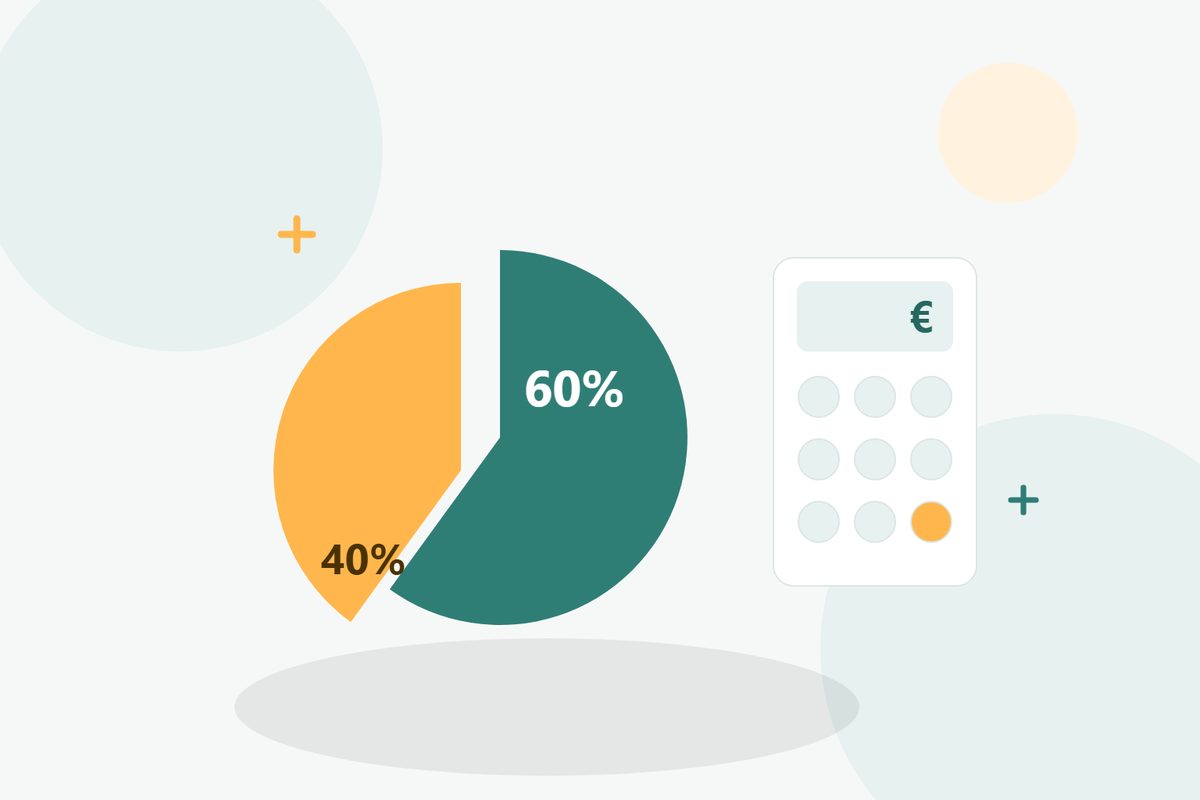
The splitting key is the percentage according to which each parent takes on a shared expense. Written as a ratio, for example 50/50, 60/40 or 70/30, it shows the proportion carried by each side. A 60/40 key means one parent covers 60 percent of the cost and the other 40 percent.
This key does not come out of nowhere. It usually stems from one of three sources:
- A court order made as part of the separation, setting out how costs are to be shared.
- A written agreement drawn up between the parents, for example as part of a consent order or a parenting plan.
- A simple arrangement between the parents, put in writing to avoid misunderstandings later.
50/50 or in proportion to income?
Two approaches dominate in practice: splitting equally, and splitting in proportion to what each parent can afford.
- 50/50 when both parents' incomes are broadly similar. Each carries half of every shared expense.
- In proportion to income when there is a gap between the two households. The higher-earning parent takes on a larger share, along the lines of 60/40 or 70/30, so that the financial effort stays balanced relative to each parent's means. This is a common fairness approach used by many families, and often by courts and mediators, rather than a rule imposed by law.
The 50/50 split is frequent, but there is nothing compulsory about it. What matters is that the chosen key reflects the real situation of both households and that both parents know it and accept it.
Calculating each share, step by step
Working out a share always follows the same sequence. The most frequent mistake is applying the key to the full amount of the expense, when anything reimbursed should be taken off first. Here is the method in four steps.
- Step 1 - Start from the amount of the expense. Note the price paid, exactly as it appears on the invoice or receipt.
- Step 2 - Deduct reimbursements and contributions. Subtract everything covered by a third party: an insurance payout, a grant, a benefit or allowance. The result is the out-of-pocket amount, in other words the sum genuinely carried by the family.
- Step 3 - Apply the key to the out-of-pocket amount. Share out that remaining amount according to the agreed percentages, not the gross figure.
- Step 4 - Read off each parent's share. Each percentage applied to the out-of-pocket amount gives the share owed by that parent.
A worked example
Take a specialist appointment billed at £320. Insurance reimburses £120. The parents have agreed a 60/40 key for this type of expense. The table below runs through the calculation step by step. The figures are a simple fictional example designed to illustrate the method.
| Step | Operation | Amount |
|---|---|---|
| 1. Amount of the expense | Price paid at the outset | £320 |
| 2. Insurance reimbursement | To deduct from the amount | - £120 |
| = Out-of-pocket amount | £320 - £120 | £200 |
| 3. Parent A's share (60%) | £200 x 60% | £120 |
| 3. Parent B's share (40%) | £200 x 40% | £80 |
| Check | £120 + £80 | £200 |
The gap with a badly ordered calculation is obvious straight away. Had the key been applied to the initial £320, without deducting the reimbursement, parent B's share would have come to £128 instead of £80. The two parents would then have been sharing a £320 expense of which £120 had already been covered by the insurer. The order of operations is not a detail: it directly changes how much each parent owes.
A different key for ordinary and extraordinary expenses
The key does not have to be unique. Many parents apply one split to ordinary expenses, the recurring costs of everyday life, and a separate key to extraordinary expenses, the more occasional and often larger ones such as orthodontics, expensive glasses or a school trip.
Nothing requires the same percentage everywhere. You can, for instance, share everyday costs 50/50 but split extraordinary expenses in proportion to income. What matters is that each category has its own clear rule and that both parents know which one applies to which type of spending.
The key is fixed at the time of the expense
One principle prevents a large share of disputes: the key applies as it stood at the moment the expense was incurred. In other words, changing the key later does not rewrite the past.
Imagine the parents move from a 50/50 split to 60/40 in September. An expense incurred in March stays calculated with the March key, the 50/50 one. Only spending after the change uses the new key. This works that way for two reasons.
- Fairness. Each expense was taken on in a specific context. Recalculating it afterwards with a different key would amount to changing the rules of the game once the game has been played.
- Simplicity. Without a fixed key, the slightest adjustment would force you to go back through the entire history of expenses and redo every calculation. A key locked at the time of the expense makes each entry final and verifiable.
In practical terms, this means a new key should never be applied retroactively to expenses already shared. Every expense keeps the split that was in force on its date.
From individual shares to a net balance
Calculating each parent's share is not enough: you still need to know who owes what to whom. For any given expense, one parent pays the full amount up front, then waits for the other to repay their share. Getting from shares to the final balance takes two steps, and the logic is the same whatever the custody arrangement.
First, for each expense, identify two pieces of information: the share owed by each parent, and the parent who actually advanced the money. Then add everything up. Total what each parent owed, total what each one advanced, and the difference gives a single net balance between the two of you.
Back to the example of £200 out of pocket, split 60/40, with parent A having paid the bill. Parent B owes their £80 share to parent A. If, over the same period, parent B has advanced an expense on which parent A's share comes to £50, the two amounts offset each other: in the end, parent B owes £30 to parent A. That net balance, once every expense has been taken into account, is the true amount to settle.
Child maintenance, extra costs and the law
Where does all this sit legally? In the UK, regular child maintenance is designed to cover the everyday costs of raising a child. Costs that go beyond it, such as school trips, private tuition, orthodontics or club fees, are typically agreed between the parents, either informally or through a written arrangement, and a court can decide if no agreement can be reached.
There is no official percentage scale for splitting these extra costs. Equal sharing and income-proportional sharing are simply the two approaches families and courts most often find fair. Other countries have their own vocabulary and their own administrative framework, but the underlying method travels everywhere: start from the expense, take off whatever is reimbursed, apply the key to the out-of-pocket amount, then settle the balance between parents.
How Kidivi calculates shares automatically
Doing these calculations by hand, expense after expense, while keeping the right key and everyone's reimbursements in mind, quickly becomes tedious. That is precisely what Kidivi automates for separated parents.
The app applies a configurable splitting key (50/50, 60/40, 70/30 and so on) and locks it at the time of the expense, so a change of key never alters past spending. A separate key can be set for extraordinary expenses. Above all, it deducts reimbursements before applying the key, in the right order, and displays a running balance in both directions: you see at a glance who owes what to whom. The detail can be viewed by month, by child and by category, every receipt is captured in seconds, and once the balance is known the repayment is recorded in one tap. If you are still weighing up how to keep track of it all, this comparison of a spreadsheet versus a dedicated app walks through the options.
In short, calculating each parent's share always comes down to applying the splitting key to the out-of-pocket amount, once reimbursements have been deducted, using the key in force on the date of the expense. Applied consistently and backed by clear records, this simple method turns a frequent source of tension into a transparent calculation whose result is never open to argument.
Document every expense in 10 seconds
Kidivi reads the receipt from a photo, separates ordinary from extraordinary costs, works out each parent's share and prepares a PDF ready for your lawyer or mediator.
Discover the app › Free · Android · Data hosted in Europe